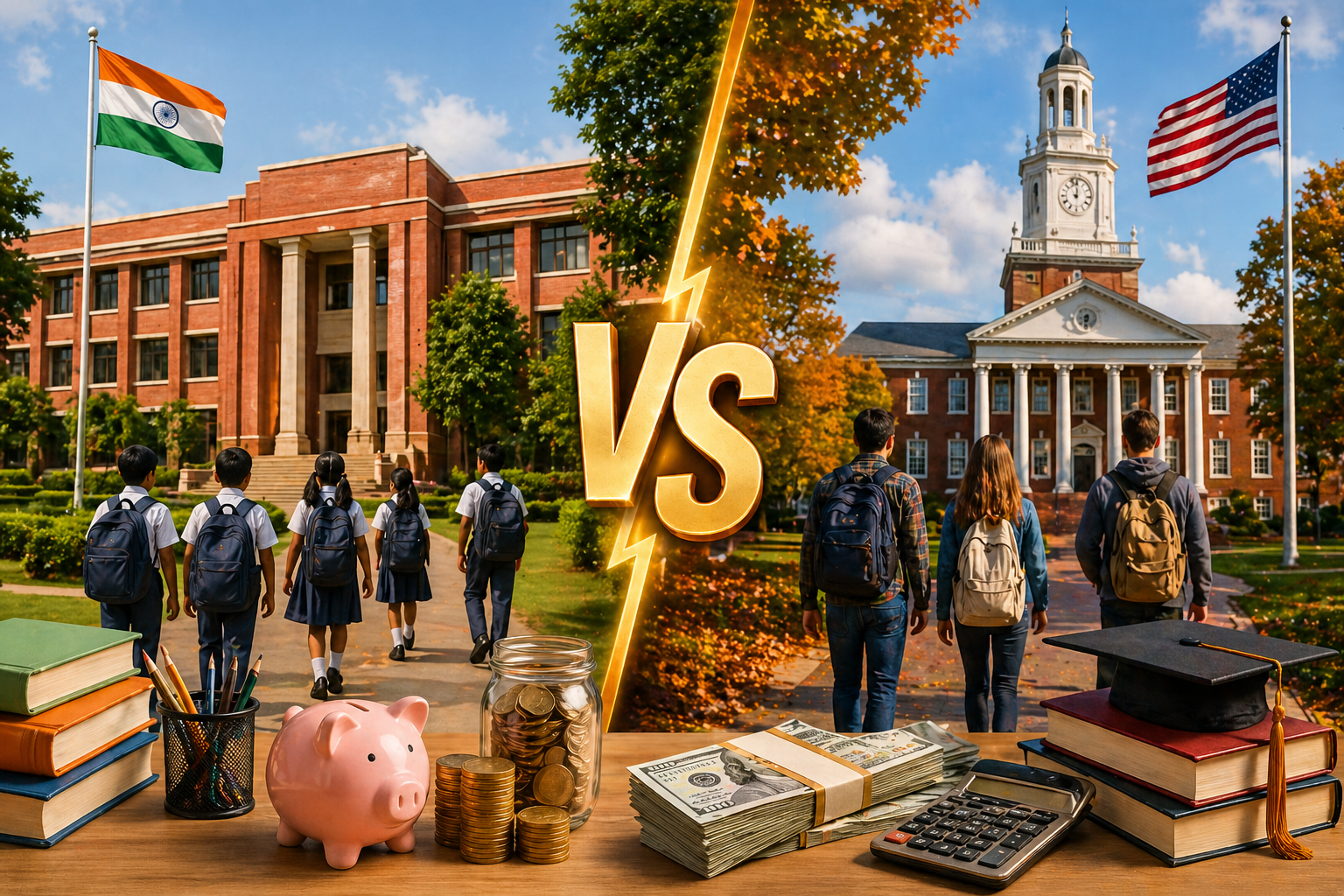
India vs USA School Fees 2026 โ€“ Simple Comparison (PPP-Based)

๐Ÿ‡ฎ๐Ÿ‡ณ โ—† ๐Ÿ‡บ๐Ÿ‡ธ
Education Finance Report ยท 2026

India vs USA
School Fees Compared

A data-driven, PPP-adjusted breakdown of what families actually pay โ€” and what they get for it โ€” in 2026.

Updated April 2026  ยท  Sources: NCES, MOSPI, IndiaSpend, PrivateSchoolReview  ยท  PPP-adjusted

Choosing between India and the USA for schooling isn’t just about fees. When you adjust for income levels, purchasing power, hidden costs, and education inflation โ€” the picture looks radically different from the headline numbers.
01

Average School Fees (2026)

๐Ÿ‡ฎ๐Ÿ‡ณ

India

Government schools โ‚น0 โ€“ โ‚น5,000/yr
Budget private (Tier 2 cities) โ‚น30K โ€“ โ‚น1.5L/yr
Mid-range private (CBSE/ICSE) โ‚น1 โ€“ โ‚น3L/yr
Elite metro schools โ‚น3 โ€“ โ‚น12L/yr
International / IB boarding โ‚น6 โ€“ โ‚น18L/yr
๐Ÿ‡บ๐Ÿ‡ธ

USA

Public schools (Kโ€“12) Free (tax-funded)
Catholic / religious private $3,500 โ€“ $13,000/yr
National avg. private school ~$14,900/yr
Independent / coastal private $28,000 โ€“ $42,000/yr
Elite boarding (7-day) $55,000 โ€“ $70,000/yr
$14,900 US avg. private school 2026
10ร— Private vs govt spend in India
38% Indian students in private schools

The US national average private school tuition hit approximately $14,888 in 2026, up from a $12,350 NCES baseline as fees have grown at 3โ€“5% annually. The highest-cost state is Connecticut at $28,472 average; New York City tops individual markets at $42,715.

In India, a 2025 household survey across 52,085 homes found that per-student expenditure in private schools is on average 10 times that in government schools. Total school-related spending (tuition, coaching, transport) represents 5โ€“10% of a typical family’s monthly budget.

02

PPP Reality: What Fees Actually Feel Like

Raw fees don’t tell the full story. Purchasing Power Parity (PPP) adjusts for what money is actually worth relative to local incomes. A โ‚น5 lakh annual fee is not the equivalent of $6,000 in the US โ€” the financial burden placed on a family is vastly different.

๐Ÿ‡ฎ๐Ÿ‡ณ India โ€” Elite school โ‚น10L/yr as % of median urban income ~72% of income
India’s median urban household income โ‰ˆ โ‚น14L/yr. Top private schools consume most of it.
๐Ÿ‡บ๐Ÿ‡ธ USA โ€” Elite private $40K/yr as % of median household income ~52% of income
US median household income โ‰ˆ $77,000/yr. Still expensive โ€” but financial aid is far more accessible.
๐Ÿ‡บ๐Ÿ‡ธ USA โ€” Average private ($14,900) as % of median income ~19% of income
The US national average private school is genuinely more affordable relative to income than India’s elite tier.
๐Ÿ‡ฎ๐Ÿ‡ณ India โ€” Mid-range private (โ‚น2L) as % of median urban income ~14% of income
Mid-range CBSE/ICSE schools sit in a similar bracket to US national-average private schools.
Key insight: India’s top private schools are more expensive relative to local income than their US counterparts. But India’s mid-range private schools are proportionally comparable to the US national average. American public schooling (free, tax-funded) has no Indian government school equivalent in quality or consistency.
03

The Real Bill: Hidden Costs

Headline fees are just the beginning. In both countries, the true annual cost can be significantly higher once everything a child’s education actually requires is factored in.

๐Ÿ‡ฎ๐Ÿ‡ณ Coaching classes (secondary)
โ‚น1โ€“2.5L/yr typical
๐Ÿ‡ฎ๐Ÿ‡ณ Transport (private school)
โ‚น20โ€“60K/yr
๐Ÿ‡ฎ๐Ÿ‡ณ Books, uniforms, activities
โ‚น15โ€“40K/yr
๐Ÿ‡บ๐Ÿ‡ธ Extracurriculars & activities
$1,500โ€“4,000/yr
๐Ÿ‡บ๐Ÿ‡ธ Technology fees
$400โ€“800/yr
๐Ÿ‡บ๐Ÿ‡ธ College test prep (SAT/ACT)
$1,000โ€“3,000 total
India’s coaching crisis: A 2025 nationwide survey found nearly 40% of secondary school students are enrolled in paid coaching โ€” up from under 25% at primary level. JEE/NEET prep coaching alone costs โ‚น1.5โ€“2.5L per year on top of school fees, pushing middle-class families to spend 10โ€“15% of total household income on education.
04

Education Inflation: The Silent Multiplier

Fees today are only part of the story. Education inflation compounds year after year โ€” often much faster than general inflation or salary growth.

10โ€“12% ๐Ÿ‡ฎ๐Ÿ‡ณ India (elite private)
Top metro private schools see 8โ€“12% annual hikes. Costs nearly double every 6โ€“7 years.
3.4% ๐Ÿ‡ฎ๐Ÿ‡ณ India (official CPI)
Official education CPI was 3.38% in Nov 2025 โ€” vastly understates what top schools charge.
3โ€“5% ๐Ÿ‡บ๐Ÿ‡ธ USA (private schools)
US private fees grew 3โ€“5%/yr, lifting the 2021 NCES baseline of $12,350 to ~$14,900 in 2026.
0% ๐Ÿ‡บ๐Ÿ‡ธ USA (public schools)
Public schooling remains free for residents. Effective inflation rate for families is zero.
Planning implication: At 10% annual inflation, a course costing โ‚น10 lakh today could cost โ‚น40โ€“50 lakh by the time a child in primary school reaches college. Indian household spending on education surged from โ‚น1.8 lakh crore in FY12 to โ‚น8.43 lakh crore in FY24 โ€” a 4.6ร— jump in 12 years.
05

What You Actually Pay For

Factor ๐Ÿ‡ฎ๐Ÿ‡ณ India ๐Ÿ‡บ๐Ÿ‡ธ USA
Public school quality Variable; significant rural-urban gap. RTE provides access but outcomes differ widely. Generally strong with good infrastructure, though quality varies by district and state funding.
Curriculum style Exam-focused (CBSE/ICSE/State boards). Strong in maths and science. IB schools offer international exposure. Holistic, project-based. Greater emphasis on sports, arts, critical thinking, and extracurriculars.
Class sizes Govt: 40โ€“60+ per class. Private: 25โ€“40. Elite: 20โ€“25. Public: 20โ€“30 avg. Private: 12โ€“18. Boarding schools often under 12.
Network value Elite schools (DAIS, Doon, Mayo, Cathedral) provide powerful alumni networks for admissions and careers. Top boarding/day schools provide Ivy League pipeline access. Network effect equally strong.
Competition level Extremely high. JEE and NEET acceptance rates under 2%. Coaching is a parallel education system. Moderate. Holistic admissions with more pathways. Elite college competition is intense but different.
Financial aid Limited at Kโ€“12. RTE 25% quota in private schools for economically weaker sections. 20โ€“30% of private school students receive aid. Awards cover 40โ€“60% of tuition on average.
06

2026 Policy Update: Delhi Fee Regulation

A major regulatory development in 2026: The Delhi government confirmed to the Supreme Court in February 2026 that the Delhi School Education (Transparency in Fixation and Regulation of Fees) Act, 2025 will come into effect from the 2026โ€“27 academic session. The law defines permissible fee components, sets accounting norms, and limits additional charges โ€” the first such comprehensive regulation of private school fees in India’s capital.

This is a direct policy response to years of unchecked fee hikes. Private school associations have challenged the law; the outcome will determine how much regulatory pressure schools face going forward and whether other states follow suit.

Why this matters: Without regulation, India’s private school sector has operated with virtually no fee oversight โ€” schools justify hikes through infrastructure, faculty costs, and “brand” positioning. The Delhi law, if upheld, could meaningfully cap the 8โ€“12% annual inflation seen at top schools.
07

Final Insight: Who Should Choose What

๐Ÿ‡ฎ๐Ÿ‡ณ

If you live in India

Mid-range private schools (โ‚น1โ€“3L/yr) offer solid academics at proportionally reasonable cost. Elite schools carry genuine network advantages but are financially stressful for most families. Budget carefully for coaching โ€” it’s nearly unavoidable at secondary level.

๐Ÿ‡บ๐Ÿ‡ธ

If you live in the USA

Public schooling is genuinely high-quality for most residents and completely free โ€” an advantage India cannot match structurally. Private schooling adds holistic programming and network value but at steep cost. Apply early for financial aid; 20โ€“30% of families receive it.

๐ŸŒ

Ultra-rich families (both countries)

Elite international schools โ€” IB, boarding, or brand-name private โ€” are chosen for network access and global mobility, not just academics. Fees ($55Kโ€“$70K in the US; โ‚น12โ€“18L in India) reflect positioning as much as education delivery.

๐Ÿ“Š

The PPP bottom line

India’s top-tier schools are more expensive relative to local incomes than comparable US institutions. The US public school system โ€” with no tuition โ€” has no equivalent in India. PPP-adjusted, the US offers better average value at the middle and lower end of the cost spectrum.

Disclaimer & Sources: Fees are approximate for the 2025โ€“26 / 2026โ€“27 academic cycle and vary by city, school type, grade, and board. US data: NCES Private School Universe Survey (2021โ€“22 baseline, projected at 4%/yr), PrivateSchoolReview.com, Research.com (2026). India data: MOSPI, IndiaSpend Comprehensive Modular Survey on Education 2025 (52,085 households), EduFund, Kotak MF Education Inflation Report (Feb 2026). PPP comparisons are simplified estimates for illustrative purposes โ€” not precise financial equivalence. Always verify fee details directly with individual schools. This article does not constitute financial advice.

Leave a Comment